
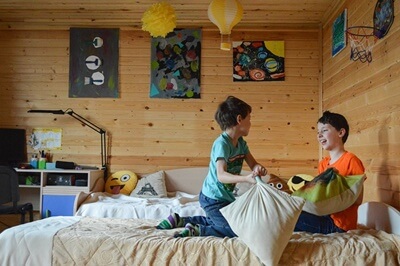
While there’s no official cut-off point when siblings should have their own bedroom by law, most parenting experts advise separating children from the age of 10.
This is especially important if your children are of different genders. Once children reach double figures, the need for modesty becomes increasingly important.
Even if children are the same sex, sharing rooms is problematic as they grow, especially if there’s a significant age gap. Different development stages have varying sleep and lifestyle needs.
Older children will struggle to share a bedroom with younger siblings due to differing bedtime schedules, and the potential for disturbed sleep for either child can hamper development.
Giving siblings their own rooms also encourages independence. It makes it likelier that children will enjoy a healthier relationship with each other instead of being forced to share a space with no respite.
If your home doesn’t have enough bedrooms to provide each sibling with their own room, consider installing a partition wall, converting another space into a bedroom, or creating a divide within a shared room that provides each child with their own space.
Why Do Siblings Need Their Own Rooms?
The idea of siblings sharing a room for a prolonged period, forming an unbreakable bond, is appealing to many parents. Unfortunately, this is not always a realistic expectation.
Here are the reasons why children over 10 years of age shouldn’t share a room:
Restful Sleep
The average sleep requirement for children and teenagers is as follows:
| 1 – 2 years old: | 11 – 14 hours sleep per day, including naps. |
| 3 – 5 years old: | 10 – 13 hours, including naps. |
| 6 – 13 years old: | 9 – 12 hours. |
| 14 – 17 years old: | 8 – 10 hours. |
Sharing a bedroom may make it difficult for both children to get the sleep they need.
Imagine that you have an 11-year-old and a 5-year-old sharing a room. The teen will be unable to access their room while the preschooler is taking a nap for fear of waking them and will invariably want to go to bed later, again risking sleep disturbance.
Equally, a younger child may not be prepared to sleep throughout the night. They may cry out after a nightmare, have an accident that requires a change of sheets, or wake up much earlier in the morning and want to play and make noise, disrupting a pre-teen’s rest.
As per Pediatrics, snoring can lead to reduced academic performance in children. While the study linked above references the snoring child themselves, a sibling losing sleep due to noise will also suffer.
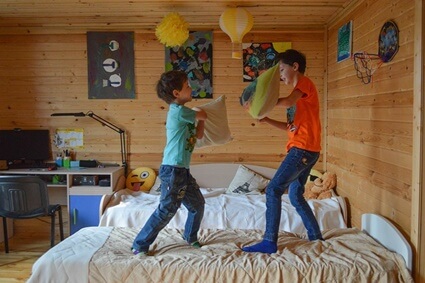
Privacy
Children in single digits are unlikely to care about roommates. For young children, sharing a room can feel like a nightly sleepover. When puberty arrives, children will need privacy.
This can be especially challenging if you have opposite-sex siblings sharing a bedroom. A teenager will not want to change in front of anybody, especially not somebody of the opposite sex.
This can become problematic if an adolescent shares a bedroom with a younger sibling who has yet to learn the importance of privacy.
Children have little control over their surroundings, and as per the Journal of Material Culture, this leads many young children who share a room to dream of their own space.
This idea of decorating a room how they wish and claiming their own territory is appealing.
If a teenager shares a room with a younger sibling who still requires parental care, your child will feel that somebody may enter their bedroom without warning.
Lifestyles and Development Stages
Once children reach adolescence, their personalities are increasingly formed.
Adolescents will develop a range of interests outside the nuclear family, expressing interest in creativity, play dates with friends, or solitary pursuits like reading a book before bed.
If an older child is forced to share a bedroom with a younger sibling, these interests can be challenging to maintain. Your child may feel uncomfortable talking to friends with a younger sibling present or find it difficult to relax in their own space.
This becomes an even bigger issue as children become teenagers. Your older child may find it impossible to study for school in a shared room, negatively impacting academic performance.
If you expect older children to share a room, they must be at similar development stages. This will likely still lead to clashes, but at least both children will understand each other’s needs.
Personality Clashes
Most parents dream of their siblings sharing a room in perfect harmony, using this common space to learn about the importance of family and strengthen a bond.
In reality, siblings very rarely coexist in peace at all times. Each child will have his or her own personality and views on what is acceptable in a shared space, likely leading to various arguments.
According to the Journal of Marriage and Family, these conflicts can be an important part of the early adolescent experience. They allow children to learn boundaries, acceptable conduct, and how to apologize and make peace after a disagreement.
Forcing warring siblings to share a bedroom means neither child has a sanctuary to retreat to, which can lead to escalation and simmering resentment. Separate rooms may be vital to managing this before permanent damage is done to a sibling bond.
Is it Okay for My Son and Daughter to Share a Room?
We’ve discussed the privacy concerns that may arise with children of the opposite sex sharing a room beyond puberty, but is it illegal for a brother and sister to sleep in the same room?
Federal law has no guidance on opposite-gender siblings sharing a room. There’s no national restriction on biological children, including step-siblings, from sharing bedrooms, regardless of each child’s sex.
Check your local state’s laws and regulations surrounding overcrowding.
You may be acting against the law by having siblings share a bedroom if this isn’t permitted, and the offense will likely be taken more seriously if the occupants are teenagers of the opposite gender.
If you’re fostering children, regulations are a little more restrictive.
Any foster child older than 3 should have his or her own bedroom. If this isn’t possible, a clear dividing line must be assigned in a shared room to ensure each child has his or her own space.
You’re unlikely to be accepted for a foster placement if you can’t provide children with their own bedrooms, including siblings, especially if the children in question are of the opposite sex.
Not Enough Space for Separate Kids’ Rooms
If space is at a premium in your home, and moving isn’t an option, you may need to think creatively to provide siblings with their own bedrooms.
Here are some possible solutions to this issue:
Repurpose Another Room
If you have a 2-bedroom home and 2 children, you may immediately think there is no choice but for your children to share a room. Think about other spaces in the house that could be converted into a bedroom, such as offices, studies, or living spaces.
Some areas will be off-limits. Bathrooms and kitchens can’t be considered bedroom spaces but could be turned into them with minimal changes if you have several living spaces.
If you own your home, consider whether a garage, basement, or attic could be turned into a bedroom. There will be essential considerations, including temperature regulation and gas and fire safety, but if done correctly, it could add value to your home.
An element of sacrifice will be required to lose space and convert it, but the rewards will be significant. Your children will likely be grateful for the opportunity to sleep alone.
Halve the Size of A Double Bedroom
Could a double bedroom be split into 2 singles by installing a partition wall? This could be the perfect solution if you meet the International Residential Code‘s minimum size of 70 square feet (6.5m2).
Children are unlikely to care about having a smaller bedroom if it means they no longer need to share. Leave enough space to satisfy their basic needs, like room for a closet, dresser, and bed.
This may seem like partition walls are quick and comparatively cheap for a tradesman to erect, but consider the additional needs and expenses involved.
Factor where you’ll place the wall concerning windows, as the occupants of both rooms will benefit from natural light. Consider providing a private door for each bedroom, allowing each child a safe entry and exit point.
Create A Wall in A Bedroom
If you’re unable or unwilling to make structural changes to our home and insist that siblings sharing a bedroom is the only option, you can still get creative.
Create a barrier in the middle of the room so each child has a unique space and territory.
The cheapest option is to hang a floor-to-ceiling blackout curtain in the middle of the room. This will be an unmistakable dividing line and provide sufficient privacy for changing and mask dim light from one side of the room.
If you prefer a more substantial solution, consider placing a double-sided bookcase in the middle of the room. Both children will have access to this for storage, which should be solid enough to create a barrier. Consider the safety protocols, ensuring the border remains firmly fixed to the floor.
If this is the route you choose, ensure that both siblings have complete autonomy over their space. Allow each child to decorate as they see fit and use their part of the room for their own needs.
While sharing a bedroom with a sibling can be a quintessential part of many childhoods, all children will eventually need a space to call their own.
It’s advisable to prepare for separate rooms when one of your children approaches the age of 10.